

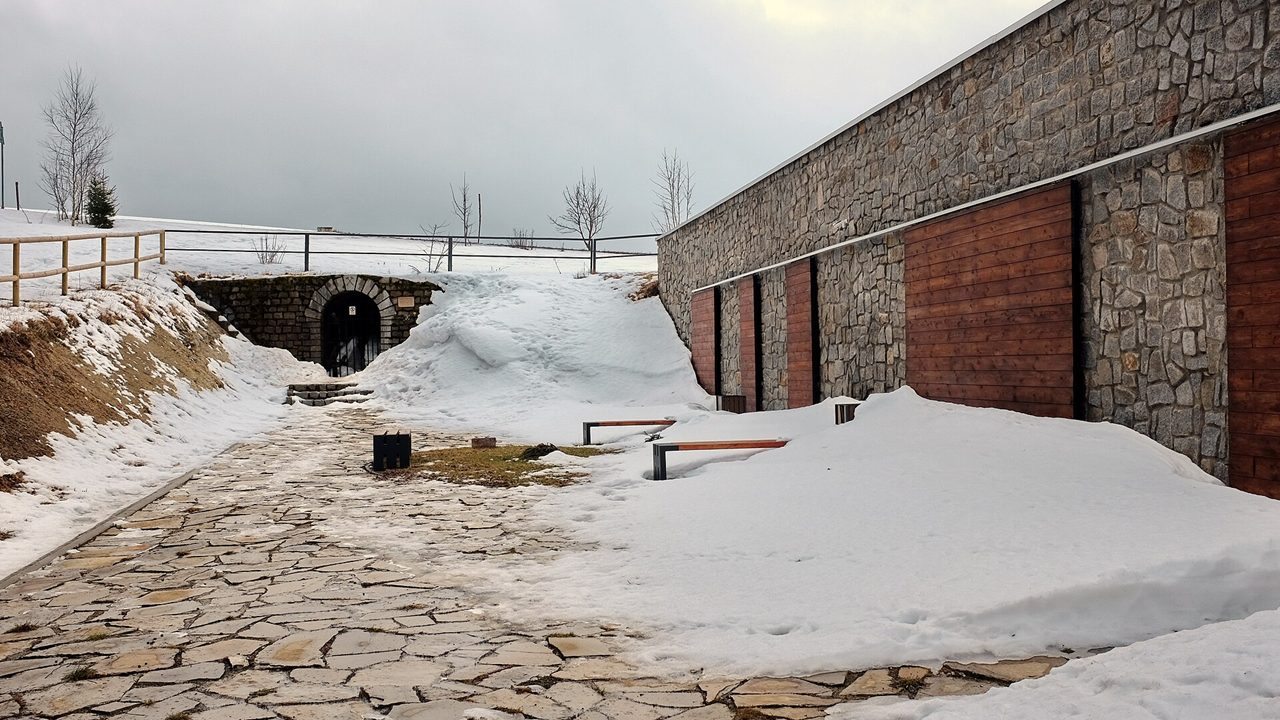
Jeroným Mine
Under a meadow near the vanished mining town of Čistá in the Slavkov Forest, a tin mine survives just as miners left it in the 16th and 17th centuries. The galleries and huge chambers were cut by hand, and the ceilings are still black from the fires the miners lit to crack the rock. The tour goes underground with a helmet and a lamp.
The story of the place
Čistá (German: Lauterbach) is first mentioned in 1350. When the tin placers in the Slavkov Forest were exhausted in the 16th century, miners followed the ore underground. The mining office registered the Jeroným mine in 1548, and three years later King Ferdinand I granted Čistá mining rights and the privileges of a royal town. The town had its own tin weigh-house, a smelter and the right to cut timber in the royal forests. According to archaeologists, underground mining here goes back as far as the 14th century.
The deposit was never rich. By the early 17th century the mines were running at a loss and were kept going only so that Čistá would not lose its mining-town status. Over the centuries an estimated 500 to 700 tonnes of tin were mined here. A fire in 1772 destroyed almost all records of the town and the mine, and by 1847 the mines were abandoned. Attempts to restart mining around 1900 and in the 1940s and 1960s never went beyond exploration. Precisely because nobody mined here later, the old workings survived untouched — elsewhere later mining destroyed them.
The miners worked with fire and iron wedges. They heated the rock with fire and cooled it quickly with water so that it cracked, then chipped it away with hammer and wedge. They advanced only a centimetre or two a day. The oldest narrow passages have an oval cross-section, most later ones a trapezoid. The main mining period in the 16th and early 17th centuries left large chambers with pillars, placed irregularly wherever the ore was richest.
Čistá itself disappeared after the Second World War. Its German inhabitants were expelled after 1945, by 1948 only seven people were left, a military training area was set up, and after it was abolished in 1954 the houses were bulldozed. Today a memorial and the marked-out floor plan of the church remain.
The mine was rediscovered in 1982 by František Baroch, when the ground caved in under his field. It became a protected cultural monument in 1990 and a national cultural monument in 2008. It opened to the public in autumn 2013; a year later it turned out to be twice as large as expected. It is run by the Sokolov Museum.
Key dates
- 1350first mention of Čistá (Lauterbach)
- 1548the mining office registers the Jeroným mine
- 1772a fire destroys the records of the town and the mine
- 1982František Baroch rediscovers the old workings
- 2008national cultural monument
- 2013the mine opens to the public
What you will see
- 16th-century chambers 10 to 20 metres wide and up to 6 metres high, with their original pillars. Between them run passages only 1.5 to 2 metres high — tall visitors walk most of the way bent forward.
- Traces of fire-setting — blackened walls and ceilings — and grooves left by the miners' wedges.
- Named chambers: Mineralogy and Geology, the Chapel with a statue of St Barbara, the Bat Chamber, the Fire-setting Chamber, Iron Water and the Work Chamber with a 16th-century pit. There are also several small pools underground.
- No electricity — the only light comes from visitors' lamps.
- Bats: ten species hibernate in the mine; in winter 2024/25 more than 450 were counted.
- The visitor building with a green roof and an exhibition on the history of the mine.
Practical tips
- From Háj: about 35 minutes by car (28 km). From Sokolov take road 210 towards Prameny, past the hamlet of Podstrání; there is a car park at the building.
- Guided tours only, starting on the hour, for groups of up to ten. Arrive a quarter of an hour early and book by phone at weekends.
- What to wear: it is about 8 °C in the mine. Bring a jacket or a warm top and sturdy shoes that can get dirty; you get a helmet and a lamp, and coats can be borrowed.
- Children from 5 years, everyone reasonably fit. Not for people with claustrophobia.
- A longer route with ladders and tighter passages runs only at weekends, by booking, for ages 12 and up.
- Cash only. There are toilets but no refreshments. The underground part is not wheelchair accessible.
- There are no captions in foreign languages; ask when booking whether the guide speaks English.
Make a day of it
Stay 19 km away
Roubenka Háj is 19 km away as the crow flies. Log cabin for 6 guests to rent in Háj near Kraslice, Ore Mountains, 18 km from Karlovy Vary. Gazebo, trampoline for kids, peace all around. Dogs welcome.